
- by Hsiao Yuh Tyng, with research by Digitery
As 2025 unfolds, so does a new playbook for digital marketing. The year 2025 stands on the onset of a new era, defined by technological innovation, data-driven decisions, and a profound shift in consumer behaviour. For professionals in Singapore and across the globe, the question isn’t just “What are the latest trends?” but “What are the most critical skills I need to future-proof my career?”
To answer this, we conducted our own research, analysing more than 120 entry-to-mid-level marketing roles. The findings revealed a clear demand for specific skill sets, which we’ve summarised in the diagram below. The top skills are no longer just about running a social media account—they are about strategic thinking, technical proficiency, and creative execution.
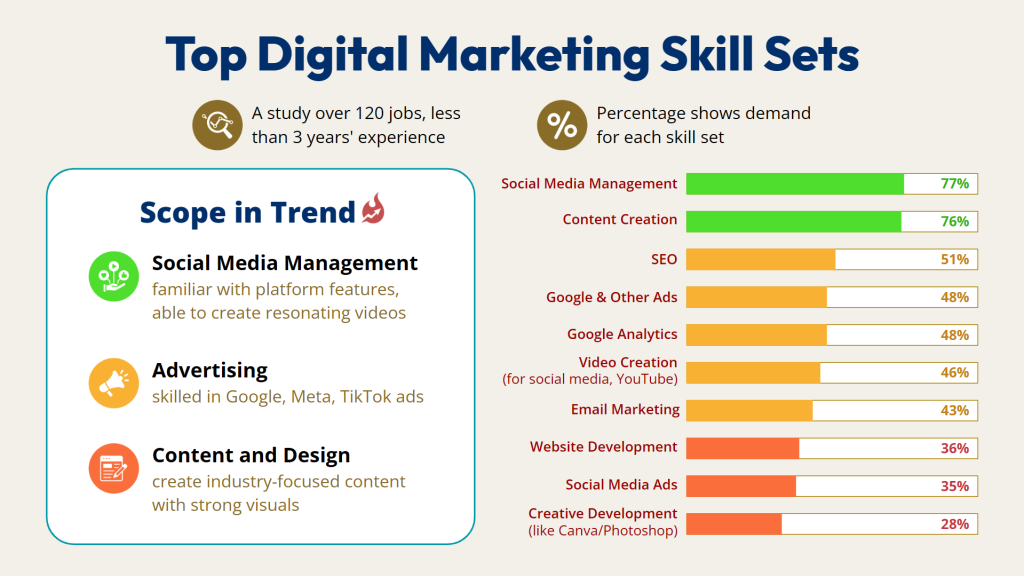
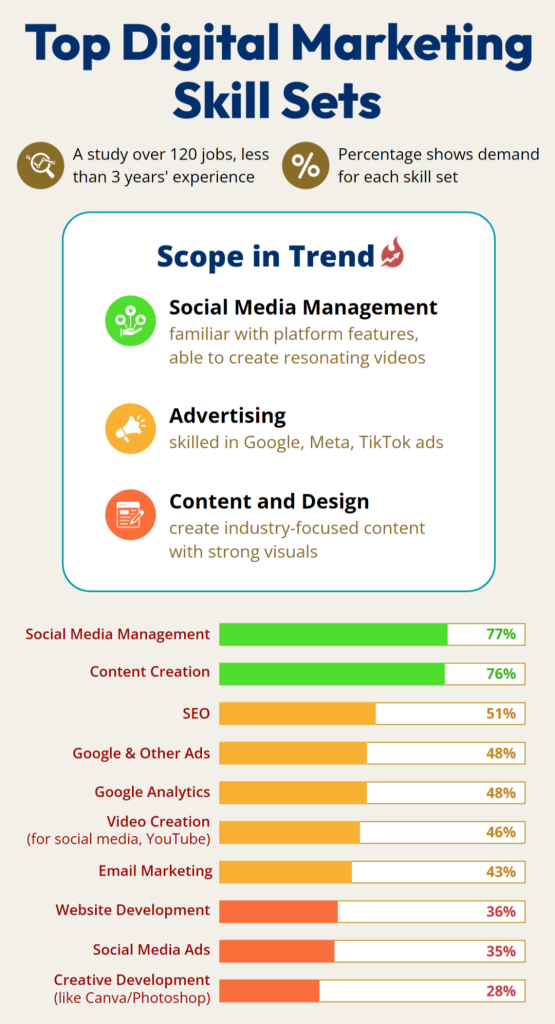
The marketing landscape is no longer a static field of traditional advertising. It is a dynamic, multi-faceted ecosystem where technology and creativity converge. According to a recent study over 120 jobs with less than three years of experience, the demand for specific skill sets is clear. As you can see in the infographic below, the top skills are no longer just about running a social media account—they are about strategic thinking, technical proficiency, and creative execution.
This article will delve into the seven most critical skills for 2025, providing a roadmap for career growth and strategic success.
1. Social Media Management: Beyond the Post
Topping the list of in-demand skills at 77% is Social Media Management. However, this is not the social media marketing of a decade ago. In 2025, it’s about a comprehensive strategy that includes community building, data analysis, and, most importantly, content that resonates. Platforms like TikTok, Instagram, and even LinkedIn now favour short-form, authentic video content, a trend that is only set to accelerate. Professionals must be familiar with platform-specific algorithms and features, able to create compelling visuals, and skilled in building and nurturing a loyal community. The focus has shifted from broadcasting a brand message to facilitating genuine two-way conversations and creating a sense of belonging for the audience.
2. Content Creation: The Visual Revolution
Coming in at a close second is Content Creation at 76%. While “content is king” is a well-worn cliché, its meaning has evolved. In 2025, content is a triple-threat game of AI tool orchestration, multi-platform optimization, and performance analysis. The ability to craft industry-focused content with strong visuals is paramount. Marketers are expected to be adept at creating everything from engaging short-form video for social media to thought leadership articles and interactive quizzes. The rise of generative AI tools like Midjourney and ChatGPT has made content creation more accessible, but it has also increased the need for a human touch—creativity, strategic storytelling, and an ability to use AI as a tool to enhance, not replace, human ingenuity.
3. SEO: The Foundation of Discovery
Securing a solid 51% demand is Search Engine Optimisation (SEO). In an age where 93% of online experiences begin with a search engine, SEO remains the bedrock of digital marketing. The landscape, however, is constantly changing. In 2025, SEO expertise goes beyond traditional keyword research. It includes a deep understanding of voice search optimization, Generative Engine Optimization (GEO) for AI-powered search results, and technical SEO to ensure a seamless user experience. Marketers need to be proficient in tools like Google Analytics 4 to track performance and turn data into actionable insights, making sure their content not only ranks but also converts.
4. The Art and Science of Digital Advertising
Digital advertising, represented by “Google & Other Ads” at 48% and “Social Media Ads” at 35%, continues to be a cornerstone of business growth. The key difference in 2025 is the emphasis on strategic, data-driven campaigns. Proficiency in running ads on platforms like Google, Meta, and TikTok is a given. What sets a professional apart is the ability to leverage predictive analytics and AI-powered campaign optimization to maximize ROI. It’s no longer about simply setting a budget; it’s about dynamic pricing, real-time ad adjustments, and hyper-personalized campaigns that resonate with a specific audience segment.
5. Data Analytics: The New Literacy
Tied with Google & Other Ads at 48%, Google Analytics and its broader field, data analytics, is now considered a fundamental skill for any marketer. Data is the compass that guides all marketing efforts. In 2025, a marketer’s ability to interpret data, identify trends, and present a compelling data-driven narrative is non-negotiable. This “data storytelling” skill is about translating complex numbers into clear, actionable insights that drive business decisions. With the shift towards first-party data collection and a privacy-first strategy, mastering advanced analytics is more crucial than ever.
6. Website Development: The User-Centric Experience
With 36% demand, Website Development is a skill that’s increasingly valuable for marketers. While this doesn’t mean every marketer needs to be a full-stack developer, a foundational understanding of front-end development, user experience (UX) design, and conversion rate optimisation (CRO) is essential. Creating a website that is not only visually appealing but also easy to navigate and optimised for conversions is a critical skill that directly impacts the success of all other marketing efforts.
7. Creative Development: The Human Touch
Finally, at 28% demand, Creative Development (using tools like Canva and Photoshop) remains a vital skill. In a world saturated with AI-generated content, human creativity is more valuable than ever. The ability to craft unique, visually stunning, and emotionally resonant designs is what will help brands stand out. This skill goes hand-in-hand with Content Creation and Advertising, as a compelling creative asset can be the difference between a forgotten post and a viral sensation.
Conclusion: The Marketer of the Future
The marketing professional of 2025 is no longer confined to a single specialty. They are a hybrid – part data scientist, part creative storyteller, and part strategic thinker, able to navigate the full spectrum of the digital ecosystem. The era of siloed roles is fading, giving rise to T-shaped professionals who combine deep expertise in one or two areas with a broad understanding of multiple marketing disciplines.
Our research reinforces this shift. The seven skills most in demand—social media strategy, content creation, SEO, advertising, data analytics, website development, and creative development—are not just industry buzzwords; they represent the real competencies employers are prioritising.
Success in this fast-evolving landscape will hinge on adaptability, continuous learning, and the ability to anticipate market shifts before they happen. Those who invest in mastering these in-demand skills: social media strategy, content creation, SEO, advertising, data analytics, website development, and creative development—will not just keep pace; they will lead.
In short, the marketer of the future is a proactive innovator, a data-driven decision-maker, and a human-centered storyteller, ready to create meaningful connections with audiences, drive measurable business growth, and shape the next era of digital marketing.