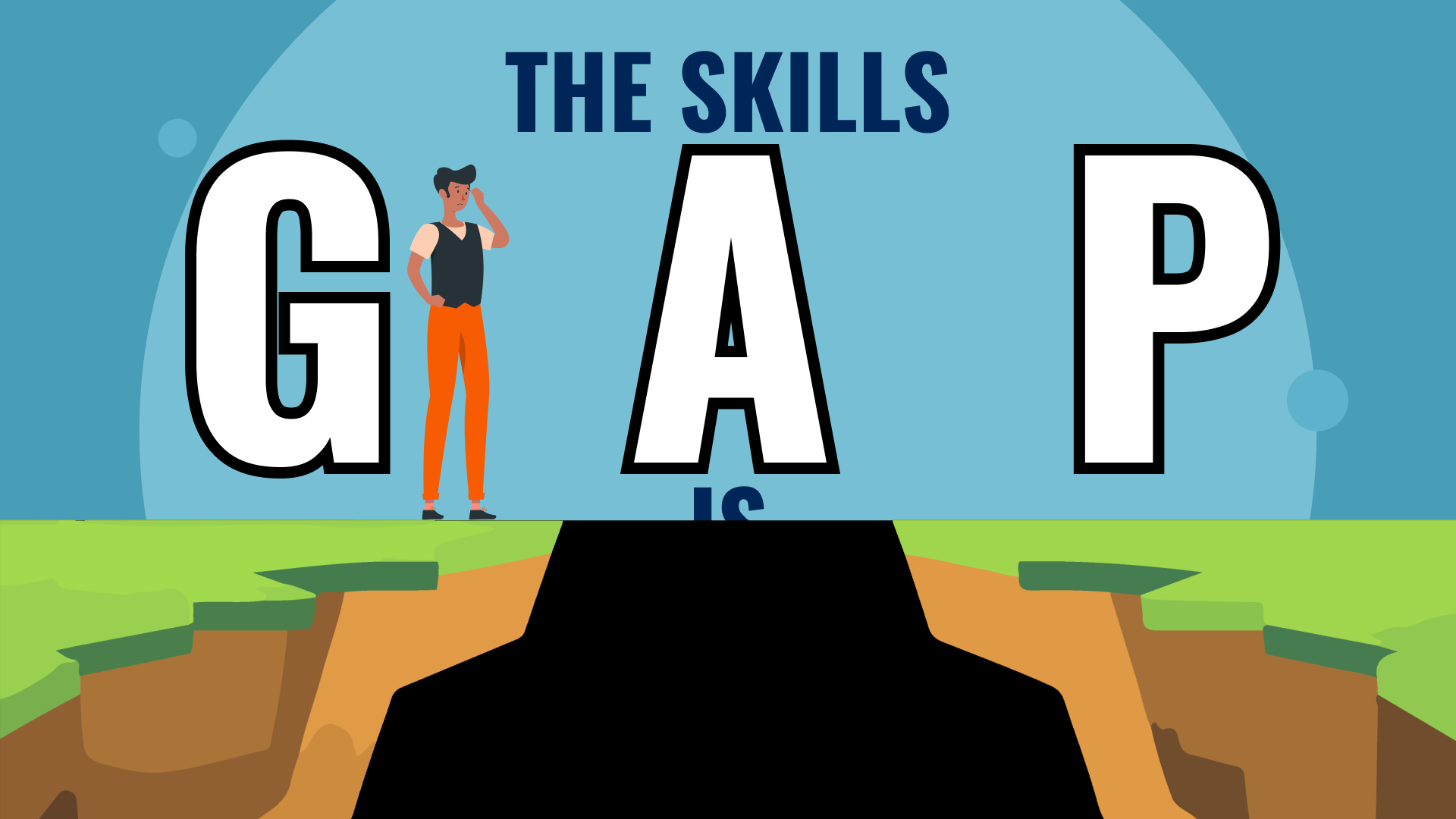
The pace of change in marketing and technology has made one thing clear: the skills that worked three years ago are no longer enough.
Across Singapore’s industries, professionals are grappling with a new reality. AI-powered search, automated workflows, and intelligent agents are no longer future considerations. They are present-day tools actively reshaping how work gets done and the gap between those who understand them and those who don’t is widening fast.
For most people, the challenge is not awareness of change. It is knowing where to start, and which capabilities matter most when time and focus are limited.
Rather than chasing every new tool, it is becoming more practical to focus on core skill areas that remain relevant across roles and industries. To help bridge this gap effectively, we recommend courses from recognised institutions aligned to the relevant skills, with up to 90% subsidies available for both individual and company-sponsored participants.
Below are three such areas that are increasingly shaping modern marketing and digital work and where you should consider focusing your upskilling efforts.
1. Social Media Strategy and Customer Engagement
Social media is no longer just about posting content. It has become a primary channel for brand communication, customer engagement, and performance-driven acquisition across platforms that each demand a different approach.
What matters today isn’t volume. It’s the ability to:
- Design content that performs across Meta, TikTok, LinkedIn, and YouTube
- Run paid campaigns with clear targeting and measurable outcomes
- Read platform data and make decisions based on what it’s actually telling you
Professionals who can do all three- not just one, are increasingly hard to find and increasingly in demand.
For those looking to build this capability in a structured way, the Advanced Social Media Marketing for Business Growth and Customer Engagement program covers the full range:
- platform strategy
- content creation
- paid media execution
- performance analysis
The emphasis is on hands-on application- campaign setup, audience targeting, and real insights, rather than theory alone.
2. Modern Search and Generative Optimisation
Search is shifting rapidly. AI-powered experiences are now sitting alongside traditional results, and content built solely around conventional SEO is losing visibility.
For marketers, this means strategy must evolve. It is no longer just about optimising for Google; it is about understanding AI AEO (Answer Engine Optimisation) and GEO (Generative Engine Optimisation) so your content is found and cited by AI tools, chatbots, and intelligent search agents.
To navigate this shift, we highly recommend focusing on a targeted learning pathway like the Modern Search Engine Optimisation and Content Marketing course. This pathway provides hands-on frameworks for building a content strategy that performs for both traditional search and the modern AI-powered web.
3. Agentic AI and Workflow Automation
AI agents are different from chatbots. They don’t just respond- they plan, reason, and execute multi-step tasks on their own. Think: emails sent, spreadsheets updated, documents retrieved, workflows run- without writing a single line of code.
The barrier to entry is lower than most expect. No programming background needed. No-code platforms like Codex app with plugins and agent skills to automate workflows have made this accessible to non-technical professionals across HR, logistics, administration, and customer support.
The Agentic AI Foundations for Non-Technical Professionals program is a two-day hands-on introduction to building and deploying agent workflows in a real business context.
Where to Start
These three skills are increasingly interconnected. Social media marketing builds active audience engagement. Modern search optimisation (AEO/GEO) ensures your brand is discovered by both users and AI agents. Agentic AI improves how work is executed behind the scenes.
For those in marketing or content roles, the first two skills heavily reinforce each other- one focuses on pushing your message out to social feeds, while the other captures high-intent traffic when people (or AI tools) actively search for answers.
Agentic AI, however, extends beyond marketing. It applies to any role where time is spent on repetitive tasks that could be structured, automated, or supported by intelligent systems.
Rather than treating these as separate disciplines, they can be seen as parts of a broader shift in how digital work is designed and delivered.
The real advantage is not in adopting every new tool, but in building skills that remain relevant as the tools continue to evolve.
If you are ready to future-proof your career or upskill your team, we recommend courses from recognised institutions aligned to the relevant skills, with up to 90% subsidies available for both individual and company-sponsored participants.